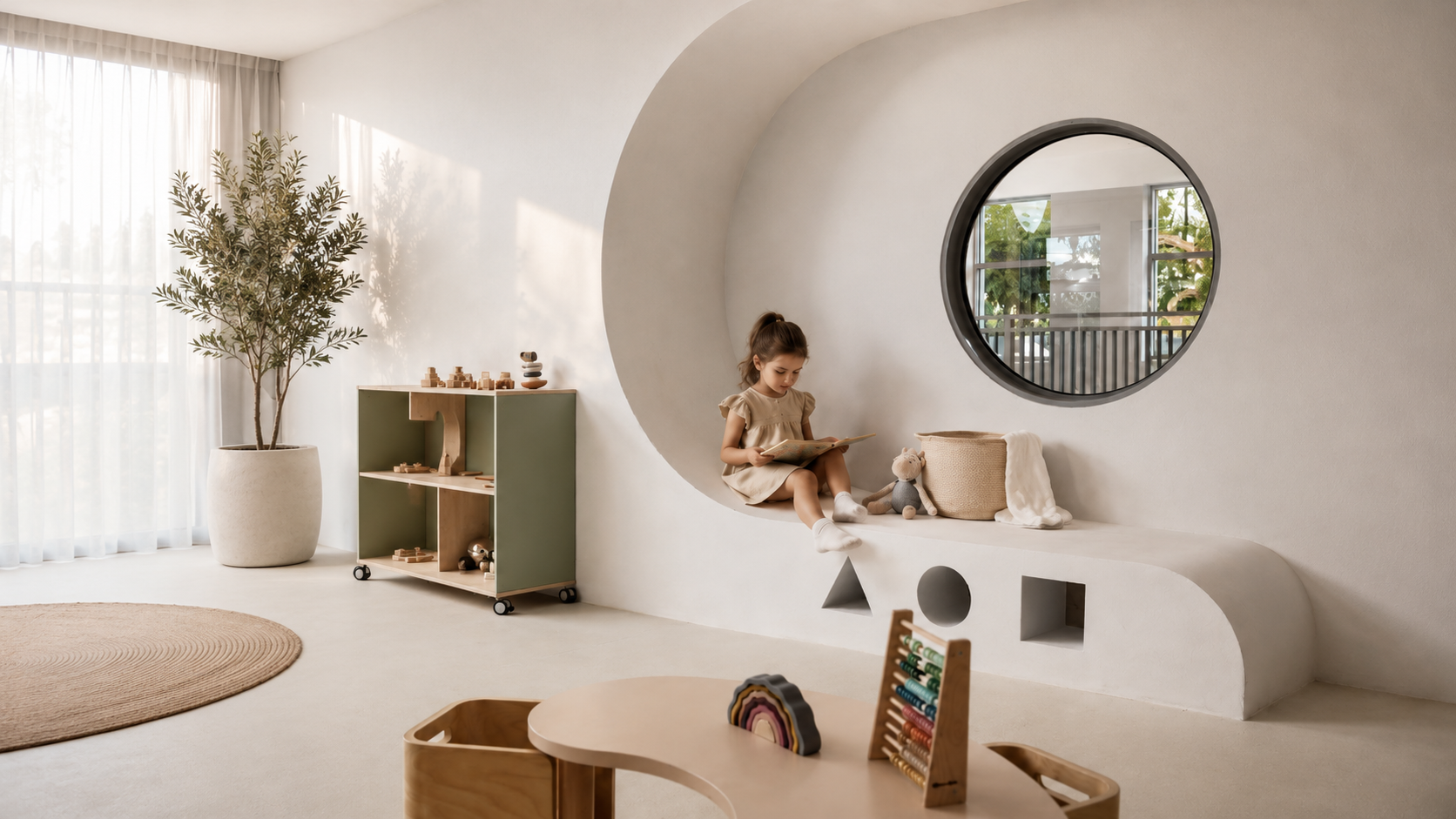
Architect, and father of two, Sherif Saad has notched up 25 years designing childcare centres across Australia. He leads Sydney-based design studio ArtMade Architects and considers his role as one of great responsibility. “A child’s formative years are critical to their cognitive development and the shaping of their personalities,” Sherif says. “It’s incumbent upon us as designers to create the best possible environments for infants, toddlers and young children to thrive.”
Embracing nature
According to Sherif, maximising natural light and ventilation, as well as incorporating natural materials, should all be high priorities for the design of childcare centres. “Nature is always regenerating and evolving,” he says. “Childcare centres should be equally dynamic environments that encourage infants, toddlers and children’s sensory engagement.”
Incorporating irregular/free-form shapes within architecture is one way to reflect the irregularities found in natural environments. “The beauty of these types of shapes is they cast an array of shadows from morning, noon to night,” Sherif explains. “These shapes help stimulate young children’s curiosity as they explore and engage with changing patterns.”
To help keep children cool in summer and warm in winter, understanding weather patterns and seasonal changes in light are equally important. “Our goal is always to work with nature to design interiors that aren’t solely reliant upon mechanical heating and cooling.”
Sherif believes visual connections to outside greenery should also be a top priority. “There’s lots of research to support the theory that connection to nature promotes a sense of emotional and psychological wellbeing at any age.”
Careful colour selection is also an important element of interior design for childcare centres. “We sparingly use ‘warm colours’ like yellows, reds and blues. They can be overstimulating in spaces reserved for more subdued activities like story time or sleeping.”
Safety and flexibility — for all ages and all spaces
Visual connection between infants, toddlers and children — and their caregivers — is essential within childcare centres. “Our designs don’t rely solely on technology to provide sightlines to children,” Sherif says. “Instead, we use strategies like lowering partition heights or incorporating transparent materials (on walls and doors) to help give caregivers clear lines of sight.
“If the location and budget allows, a pavilion-style building delivers great flexibility in terms of how different zones can be configured to maximise visibility between caregivers and children,” Sherif explains.
Layouts that facilitate age-appropriate segregation, the use of safe and age-appropriate materials, and secure entry and exit points are also key design considerations.
